
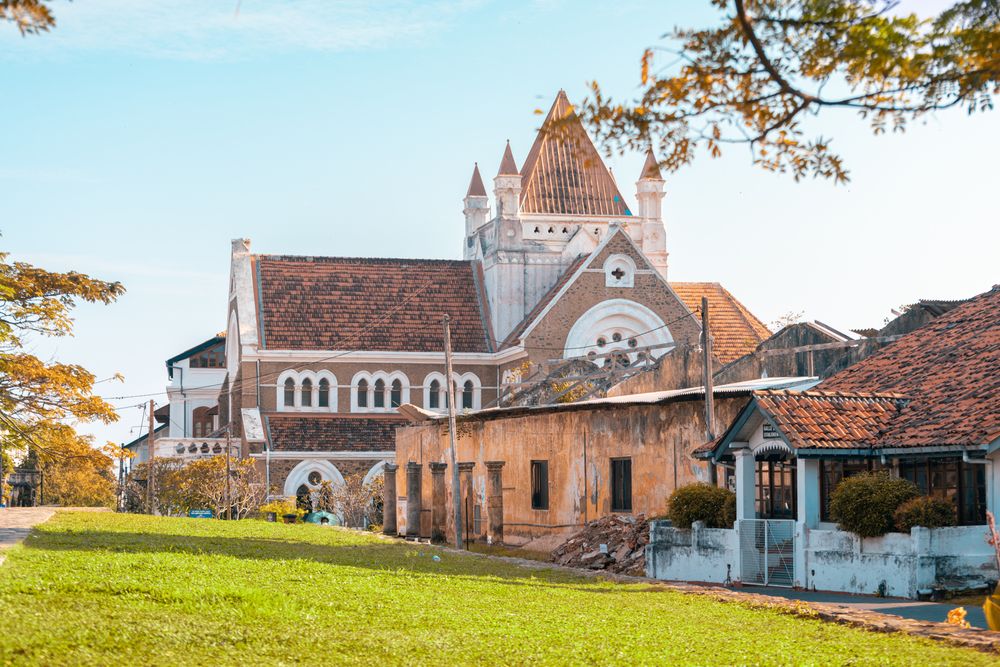
The essential places inside Galle Fort are the seaward ramparts, Flag Rock Bastion, the lighthouse, the Clock Tower, the Dutch Reformed Church, the National Maritime Museum and the streets around Church Street, Pedlar Street and Leyn Baan Street. The Fort’s deeper character is found in its restored courtyards, galleries, workshops and religious buildings.
Galle Fort is not a preserved shell. It remains a living quarter where homes, hotels, schools, mosques, churches, museums, restaurants and shops occupy a fortified city shaped over several centuries.
The Portuguese established the settlement in the 16th century, and the Dutch expanded it into the form largely recognised today. UNESCO inscribed the Old Town of Galle and its Fortifications in 1988, citing the interaction between European architectural models and South Asian traditions. Coral and granite were used in the ramparts, while local knowledge shaped the fort’s response to climate and place.
Which Ramparts Should You Walk?
The complete rampart circuit is rewarding, but visitors with limited time should prioritise the seaward section between the lighthouse and Flag Rock.
Flag Rock Bastion offers broad views over the Indian Ocean and is popular around sunset. The route towards Triton, Neptune and Clippenberg bastions reveals how the fort’s defensive edge now functions as a public promenade. At the landward side, the Clock Tower and Moon Bastion provide a different perspective, looking towards modern Galle rather than the open sea.
Wear comfortable footwear. The walls can be exposed to strong sun, wind or rain, and some surfaces are uneven.
Why Is the Lighthouse Important?
The white lighthouse has become Galle Fort’s most recognisable visual landmark. Its position near Point Utrecht Bastion makes it especially photogenic against palms, white walls and the sea.
Rather than treating it only as a photograph, use it as an orientation point. From here, the streets behind the ramparts lead towards the mosque, colonial houses, museums and commercial lanes.
What Should You See Beyond the Ramparts?
The Dutch Reformed Church on Church Street contains evidence of the town’s Dutch colonial history, while the National Maritime Museum occupies a former Dutch warehouse and interprets the region’s relationship with the sea.
The Old Dutch Hospital represents another stage in the Fort’s continuing adaptation. Once used for colonial medical purposes, it has been restored as a dining and retail precinct. This reuse reflects a broader pattern inside the Fort, where historic buildings continue to serve contemporary functions. Religious diversity is equally important. Churches, Buddhist sites and the Meeran Mosque reflect the communities that have lived and traded within and around Galle over time.
Where Can You Find Art?
Galle Fort’s art scene is distributed across galleries, design shops and restored townhouses rather than concentrated within a single museum district.
Stick No Bills occupies a historic Church Street townhouse and specialises in authorised travel and cinema poster art connected to Sri Lanka and other destinations. Its setting allows visitors to experience the artwork within the rooms of an old colonial building rather than a neutral gallery.
Other spaces around the Fort present painting, craft, textiles, antiques and contemporary design. Because galleries and independent shops can change location or opening hours, visitors should verify current details before travelling.
Where Are the Hidden Courtyards?
The most atmospheric courtyards are often visible behind restaurants, galleries, hotels and restored residences. They typically combine thick walls, shaded verandas, internal gardens and tiled floors; architectural responses to tropical heat as much as expressions of style.
Not every courtyard is public. The best way to encounter them respectfully is through venues that welcome visitors, such as galleries, museums, shops or restaurants. Ask before crossing a threshold or photographing a private interior.
How Long Should You Spend?
Allow at least half a day for the ramparts, principal monuments and several interior stops. A hurried two-hour visit can cover the highlights, but it will miss the pauses that make the Fort memorable.
A thoughtful sequence is:
- Enter near the Clock Tower in the morning.
- Walk towards Church Street and the Dutch Reformed Church.
- Visit a museum or gallery.
- Continue to the lighthouse.
- Follow the seaward ramparts towards Flag Rock.
- Pause for lunch or return in the late afternoon for changing light.
What Should Visitors Know?
Dress comfortably and respectfully, particularly when entering places of worship. Ask permission before photographing people. Avoid climbing on fragile walls or entering private property.
August visitors should carry a light rain layer and remain flexible. The Fort is especially atmospheric under changing skies, but exposed ramparts should be avoided during lightning, heavy rain or unsafe wind conditions.
Visiting from Koggala
The Fortress Resort & Spa is positioned in Koggala, allowing guests to experience a beachfront stay outside the walled town while visiting Galle Fort as a curated excursion. The resort’s Galle Fort experience introduces the site’s Portuguese origins and later Dutch expansion, while the concierge can assist with transport and local planning.
The value of Galle Fort lies not only in what has survived, but in how the town continues to evolve inside its walls. Walk the ramparts, but also look through the doorways. The history of Galle is written in both stone and daily life.